
How I Squatted 800lbs

While this may not get YOU an 800lb squat, at the very least I hope it can put some pounds on it.
I am just getting back into the swing of some undirected training post-meet and wanted to detail the squat cycle leading up to the meet I competed at this past October. I think this would work equally well from a raw or equipped squatter, specifically those who don't react too well to overzealous amounts of accommodating resistance. Hopefully this article gives insight into the "how" and a little bit of the "why."
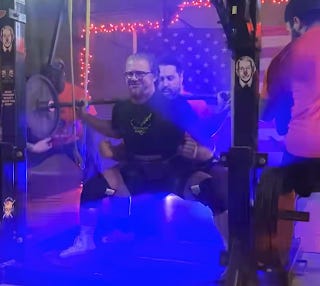
For some time now I have only been squatting once a week, and pulling or doing goodmornings on the second lower day. While the second day has relation, it's less strict as the squat waves still largely dictate the tone of the rest of the week's training. Essentially, it takes the core of what Hoff and Oliveira have revealed through their podcast appearances and tweaks the broader periodization of their 4th week, which is when you free squat.
Now, who the actual fuck am I two question the GOAT and one of his training partners- who is an incredible lifter in his own right and proven coach? My squat is pond scum compared to theirs... and that's why I changed some elements. I'm at a much different point in my career than both of them, and because of this I needed to change some things to make it work for me.
The biggest thing for me was their last free squat day of the training cycle, where (according to what I have gathered from them) they take all 3 squat attempts. For them, they are treading through conquered land. They are taking numbers they have largely already hit and using that to build a total to place well at the WPO. For me, my third squat is a Hail Mary. This meet I fortunately had a stellar day and smoked my third, but I was planning to build my total on my seconds and thirds were all just an "if everything goes well, fuck it" kind of number. Because of this, I did not think it wise to push for a pretty ballsy PR in the gym on my last free squat day a little over 21 days out. At this point in the training cycle, I'm not getting any stronger; but I can sure as hell fuck the whole thing up over one squat gone awry with no time to recover.
I also would like to add a small footnote that I do not know exactly what Hoff or Oliveira or any of the Night Crew does. They are fairly secretive about their training and don't post a ton, so I am only pulling from what I have access to.
Another group I pulled from was Big Iron (*very* loosely) and arguably Joey Smith of NEBO Barbell. I only realized after I wrote it out when I listened to his Table Talk that the NEBO team does some similar things with reverse bands, but I originally got the thought of tapering them down from some random articles/logs I found deep down internet rabbit holes detailing some of the work Big Iron did. I also would be remiss to not thank my great friend Paul Stein for sending me some Big Iron related resources, as well as Brandon Mitzel (who trains at Jim Grandick's current-day Big Iron Compound) for sharing some information on what they did and still do today.
With the background out of the way, here is an overview:
3 Week DE Squat Wave (briefs, to a box)
Week 4: Free Squat (full gear) reverse Monster Minis
3 Week DE Squat Wave (briefs, to a box)
Week 4: Free Squat (full gear) reverse Minis
3 Week DE Squat Wave (briefs, to a box)*
Week 4: Free Squat (full gear) straight weight; opener
Taper into Meet
I hope the general outline is clear. Essentially, do a DE Lower wave, and "in between" waves take a full gear free squat and as you get closer to the meet, use less reverse bands. This allows you to handle competition-level weights (if not greater) far out from the meet; and as opposed to say a chain squat, you are still taking the weights full range. This was helpful for me because I struggle with both depth and strength/positioning in the hole, so it allowed me to practice more.
With the general information out of the way, lets get a bit more into the specifics. The DE squat waves are also important in terms of exercise selection. This time around, the first wave shown was with the cambered bar and blues over the plates (the accommodating resistance isn't as important but the bar/weight is), the second wave with the bow bar and chains, and the final wave with the bow bar against blues (this wave had an asterisk for a reason, we will talk a little more about that later). Obviously, I can squat more with a straight bar (i.e. the baseline for the bow bar waves) than I can with the cambered bar. Before what was outlined above we did a wave with the SSB and chains, and again I can squat less with the SSB than I can a cambered bar. Because of this, the bar weight, and therefore the workload (sets*reps*weight, we do not account for AR in this equation though), is increasing every wave. This raises your state of preparedness while merely maintaining volume.
So, the wave with the SSB over 3 weeks would be something like this:
Week 1: 12x2@295+chains (7080lbs)
Week 2: 12x2@335+chains (8040lbs)
Week 3: 10x2@395+chains (7900lbs), maybe working up the last two doubles if all went fast beforehand
This leaves us with an average workload of ~7673lbs (not accounting for working up).
The next wave with the cambered bar (after a free squat between these two waves) would look something like this:
Week 1: 12x2@335+bands (8040lbs)
Week 2: 12x2@385+bands (9240lbs)
Week 3: 10x2@425+bands (8500lbs), maybe working up the last two doubles if all went fast beforehand
This leaves us with an average workload of ~8593lbs (not accounting for working up).
Despite volume and relative intensity over both waves being the exact same, workload went up just from being stronger on one bar than the other. This is then carried into the bow bar, where workload raised even higher. I would also like to note we take quarter-plate jumps, mostly for convenience and it helps meet in the middle between my training partner and I in terms of strength differences/gear proficiency.
The final wave, however; we ratcheted a jump down. So, instead of going three-quarter, four, four-quarter; we went three, three-quarter, four plates against blues (due to timing we actually cut the third week out and shortened this to a two week wave to make room for openers and a taper after but the concept still stands). However, to account for the drop in workload, we made up for it with reverse hyper workload. Here's what the last two waves would look like:
Week 1: 12x2@370+chains (8880lbs)
Week 2: 12x2@410+chains (9840lbs)
Week 3: 10x2@460+chains (9200lbs), maybe working up the last two doubles if all went fast beforehand
Week 4: Full Gear Free Squat with Reverse Minis
Week 1: 12x2@320+bands (7680lbs) + ~1200lbs reverse hyper workload
Week 2: 12x2@370+bands (8880lbs) + ~960lbs reverse hyper workload
Week 3: 10x2@410+bands (8200lbs) + ~1000lbs reverse hyper workload, no working up under any circumstances this week
Week 4: Opener- full gear straight weight
Week 5 & 6- deload into meet day
I must give all credit to my training partner Zach Santangelo for this portion. He suggested this to begin taking some load off of my spine as we approached the meet. Where he got it from (if he got it from somewhere) I do not know.
As a whole, I really enjoyed this and am most certainly going to repeat the overall format the next time I decide to go into a full power meet.
Obviously, you do not need to use these exact weights; I am just showing what I did based on my training numbers to create a functional model to adapt to yourself. If this is something that you end up trying, I would love to hear how you fare with it!